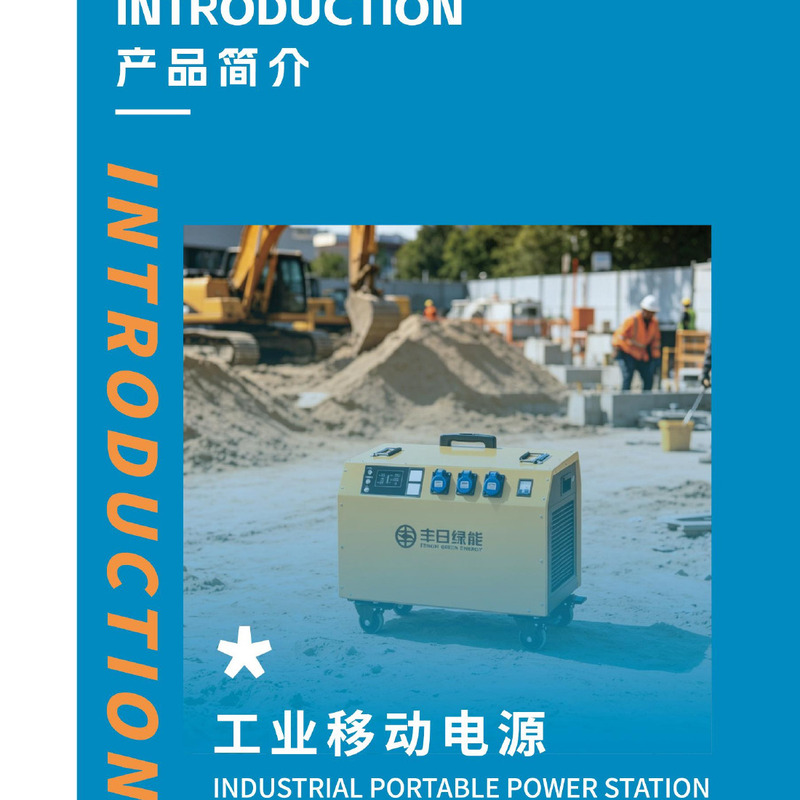
If you searched for a CIC (commercial & industrial) powerbox in Australia, you're shopping the wheeled, site-grade class of battery power — the kind you roll onto a remote mine site, Outback telecom tower, regional construction job or caravan park and plug in. Here is the framework we give Australian buyers deciding between a generic CIC box, the NovaBESS PowerBox, a diesel generator and a consumer portable power station.
The category, and why it is its own buying decision.
A CIC powerbox is a wheeled, industrial portable power station: a LiFePO4 (or sometimes unspecified lithium) battery in a rugged enclosure with its own outlets, no fixed installation. It is the middle ground between a wall-mounted home battery (permanent, wired) and a diesel generator (fueled, loud, fume-producing). In Australia this class is increasingly replacing small diesel sets on remote and temporary sites where a fuel run is hours away and noise near communities is a problem.
That single sentence already rules some options in and others out. The four realistic alternatives below cover almost every Australian commercial & industrial scenario — and the honest answer is that no single one wins them all. The job is to match the option to the duty.
The loads where a wheeled CIC box beats a generator or a residential unit.
WA and QLD pit camps, exploration and processing sites use battery power for non-critical, noise-sensitive loads — and for IECEx-aware deployments where fume-free indoor power matters. A full generator stays for prime power; the box handles the rest.
Blackspot and NBN-co rollout towers, off-grid repeaters and monitoring stations. When the nearest fuel is 200 km away, three-source charging (wall + solar + generator) beats a diesel run every time.
Civil works, road and FIFO site offices near communities want quiet power. A ≤75 dB(A) battery set draws none of the complaints a diesel generator does at 7 a.m.
Parks, outback stations and remote tourism operators run silent overnight power without a humming genset — and without carting jerry cans.
| Dimension | Generic CIC box (off-the-shelf) | NovaBESS PowerBox | Diesel / gas generator | Consumer portable station |
|---|---|---|---|---|
| Capacity | Varies widely (1–10 kWh typical) | 4.02 / 8.04 / 16.08 kWh | effectively unlimited while fueled (2–10 kW common) | 1–3.6 kWh (rarely site-grade) |
| Continuous power | Often unspecified | 500 / 1,000 / 1,500 W | 2,000–10,000+ W | 1,000–3,600 W (surge) |
| Mobility | Wheeled, quality varies | Wheeled, 26 / 57 / 100 kg | Wheeled / frame, heavy | Carry handle, <20 kg |
| Noise & fumes | Silent, fume-free (battery) | ≤75 dB(A), fume-free, indoor-safe | 85–100+ dB, exhaust / CO | Silent, fume-free |
| Charging / fuel | Usually wall only | Wall + solar + generator (3 sources) | Diesel / petrol, refuel runs | Wall / solar (some) |
| Chemistry | Unspecified / mixed | LiFePO4, 314 Ah cells | n/a (engine) | Usually NMC / LFP mix |
| Certifications | Sometimes basic CE only | CE · UN38.3 · UL · IEC 62619 | Emissions regs, not battery certs | CE / UL (consumer) |
| Maintenance | Low, support unclear | Low, manufacturer-backed | Oil, filters, servicing | Low |
| Best for | Cost-first, low-risk loads | Temp / mobile / off-grid C&I loads | Days-long prime power | Personal / light use |
| Indicative cost | ~$400–1,500 | Quote-based — see $/kWh calculator typically $400–900/kWh equipment |
~$500–3,500 + fuel | ~$1,000–3,500 |
Figures are indicative and vary by market, capacity and order volume. NovaBESS specifications are from the manufacturer catalog (PowerBox: 4.02 / 8.04 / 16.08 kWh, 12.8 / 25.6 / 51.2 V, 500 / 1,000 / 1,500 W, LiFePO4 314 Ah, 80%–100% DoD, air-cooled, ≤75 dB(A), CE / UN38.3 / UL / IEC 62619). Generic CIC boxes and consumer stations are described as a category; confirm named cells, BMS and certifications with any supplier before import or site use. For Australia, confirm RCM/EESS market access and any IECEx/site requirement with NovaBESS before deployment.
Where each one wins — and where it doesn't.
Cheapest entry into the category, and fine for low-consequence loads. The catch is usually the unknowns: unnamed cells, unspecified BMS, and certifications that may not clear customs or satisfy an insurer.
✓ Lowest up-front price
✗ Certs / support often unclear
Named LiFePO4 cells, full CE / UN38.3 / UL / IEC 62619 marks, and a 40-year manufacturer behind it. Charges from wall, solar or generator — a big deal when the nearest fuel is 200 km away. The pick for temp / mobile / off-grid C&I work, and for distributors wanting a white-label model.
✓ Certified, supported, multi-source
✗ Quote-based, not a $99 import
Still the king of days-long, whole-site prime power in the bush. But it is loud, exhaust-producing, needs fuel runs and servicing, and cannot run safely indoors.
✓ Unlimited runtime while fueled
✗ Noise, fumes, maintenance, fuel
Brilliant for personal and light use — quiet, clean, easy to carry. But capacity and build are not site-grade, and most lack the certs and duty rating for commercial deployment.
✓ Light, cheap, user-friendly
✗ Not rugged / certified for C&I
The checklist that actually separates a good buy from a risky one.
Match the option to the duty — most Australian commercial buyers end up with a mix.
Roll-in, plug-in power for mining, telecom, remote construction and tourism → NovaBESS PowerBox. Fast, quiet, fume-free, certified.
A fixed cabinet or container BESS is the right tool for solar, peak shaving and whole-site backup → see our Commercial & Industrial BESS line.
Whole-site, continuous duty for days in the bush → a diesel / gas generator still wins on runtime. Keep a PowerBox alongside for silent, indoor-safe sensitive loads.
Camping, vanlife, a laptop and a fridge at home → a consumer portable station is the simpler, cheaper fit. Step up to PowerBox only when duty goes site-grade.
Honest positioning: not the cheapest box, but the one built for the job and the border.
If your loads are temporary, mobile or off-grid, PowerBox is the option that removes the three things generators and imports can't: noise and fumes indoors, uncertain certifications, and no path to your own brand. For Australia, three-source charging (wall + solar + generator) means a remote site stays powered without a fuel run — critical when the bowser is hours away. It runs on named LiFePO4 cells, carries CE / UN38.3 / UL / IEC 62619, and is offered as a proven white-label model through our OEM / ODM program.
This guide covers Australia. See the others in the cluster:
UL 2743, CSA, cold-climate mining and telecom — the buyer's framework for the US and Canadian market.
Read →CE / UKCA, city-site diesel limits, the UK red-diesel phase-out — the framework for European buyers.
Read →The universal framework: generic CIC box vs NovaBESS PowerBox vs generator vs consumer station.
Read →A CIC (commercial & industrial) powerbox is a wheeled, site-grade portable power station built for places where fixed wiring is impractical — remote mine sites, Outback telecom towers, regional construction jobs, caravan parks and off-grid tourism. In Australia this class is increasingly replacing small diesel sets on temporary and mobile loads where a fuel run is hours away and noise near communities is a problem. You need one (rather than a residential unit or a generator) when the load is temporary, mobile or off-grid and you want silent, fume-free power you can roll in and plug in within minutes.
For electrical equipment placed on the market, look for RCM (the Electrical Equipment Safety System / EESS mark) and UN38.3 for transport by air and sea. IEC 62619 covers the industrial lithium cells. For mining or potentially hazardous areas, IECEx / AS-NZS 60079 awareness matters for the deployment, not necessarily the box itself. NovaBESS PowerBox carries CE / UN38.3 / UL / IEC 62619 — confirm RCM/EESS marking and any site-specific requirement with us for your application before import or site use.
For most professional Australian buyers, yes. A generic off-the-shelf CIC box is often cheaper up front, but the cells, BMS and certifications are frequently unspecified — a real risk at the border (UN38.3) and for site safety and insurance. NovaBESS PowerBox uses named LiFePO4 314 Ah cells, carries CE / UN38.3 / UL / IEC 62619, and is backed by a 40-year manufacturer with OEM / ODM and after-sales support. If you are a distributor, rental fleet or brand owner, the white-label option is the bigger differentiator than price alone.
For most temporary and sensitive loads, yes. A battery powerbox is silent (≤75 dB(A)), fume-free and indoor-safe — it runs inside a site office, donga or workshop where a diesel generator cannot. It will not match a generator for days-long, whole-site prime power, but for tools, lighting, comms, pumps and backup it removes fuel, noise and exhaust, and three-source charging (wall + solar + generator) keeps a remote site powered without a fuel run. Many Australian operators keep one of each for different duty cycles.
Yes. The NovaBESS PowerBox is a proven white-label model in our OEM / ODM program — your logo, label and packaging, with minimal engineering overhead. We also support custom variants (capacity, enclosure, BMS, CAN / RS485 protocol). That is the path most distributors, rental fleets and brand owners take instead of relabeling an unspecified import box, and it gives you a defensible product for the Australian market.
Tell us your duty cycle and site type — mine, telecom, construction or tourism — and we'll size the model, confirm certifications for the Australian market, and quote branded or OEM supply.